




Product Logic: Timekeeping First, Radio Second
Direct clock controls for low-friction bedside use
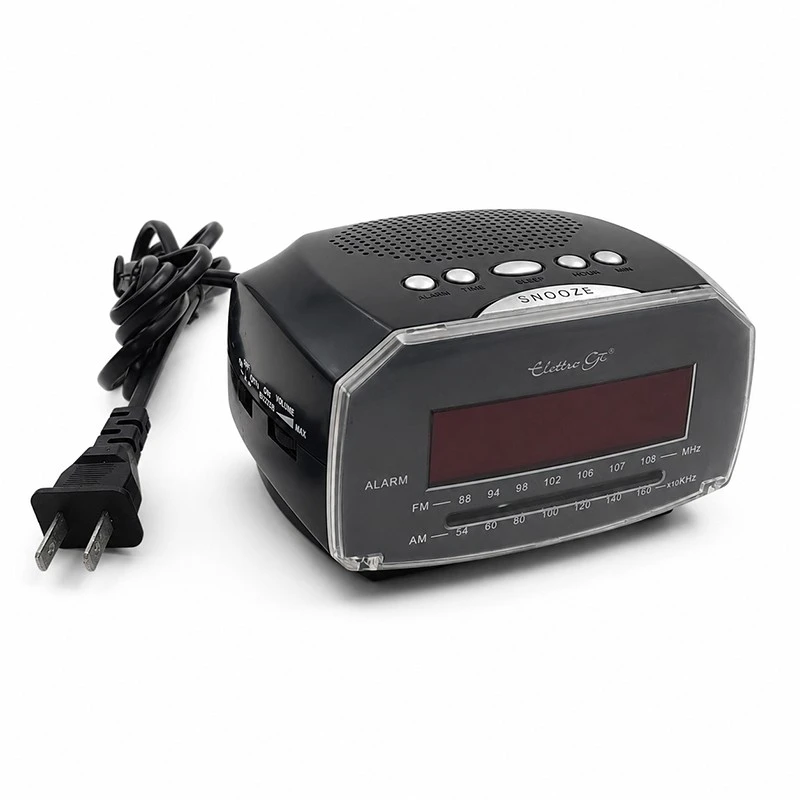
Dedicated Alarm, Time, Sleep, Snooze, Hour and Minute controls keep the core routine visible on the product. This matters in hospitality and bedroom channels, where users may operate the unit in low light and do not want layered menus.
AM/FM reception with a familiar tuning experience
The supplied specification lists AM 540-1600 kHz and FM 88-108 MHz. Manual tuning and an illuminated frequency indicator preserve a traditional radio experience for news, talk and music listening.
AC-powered design for permanent indoor placement
HT-001 is specified for 220V AC operation. The commercial proposition is therefore stable bedside or desk use with regular wall power, not travel, emergency backup or rechargeable operation.
Close-range audio for a small room
A 50 mm, 8Ω / 0.5W loudspeaker handles alarm sound and radio playback. The audio system is intended for a nightstand, desk or small indoor space rather than high-output portable listening.
Technical Reference for Sourcing
|
Item |
Confirmed specification |
Item |
Confirmed specification |
|
Model |
HT-001 |
Product name |
Bedside Clock Radio |
|
Power input |
220V AC |
Radio bands |
AM / FM |
|
AM |
540-1600 kHz |
FM |
88-108 MHz |
|
Loudspeaker |
50 mm, 8Ω, 0.5W |
Antenna |
Soft antenna |
|
Clock functions |
Alarm / Time / Hour / Minute |
Convenience |
Sleep / Snooze / automatic radio |
|
Frequency indicator |
Illuminated |
LED section |
71 x 19 mm |
Where a Bedside Digital Clock Radio Fits in a Buyer Range
HT-001 should be positioned by room and routine rather than by portability. The buyer is selecting a fixed-location clock-radio for repeated daily use, so ease of operation, clear labeling and stable mains-power compatibility matter more than battery capacity or outdoor features.
Bedroom and nightstand retail
For home channels, the strongest message is the combination of local AM/FM listening with alarm, sleep and snooze functions. The compact control layout suits consumers who want a recognizable bedside product without app pairing or menu-heavy setup.
Hotel and serviced-accommodation supply
Hospitality buyers need controls that different guests can understand quickly. A fixed AC supply, direct alarm controls and a visible frequency indicator make the model suitable for rooms where the product remains installed rather than carried around.
Dormitory, office and compact indoor spaces
On a dormitory shelf or office desk, the unit adds radio listening and timekeeping without taking the place of a larger home-audio system. The small-room audio output also matches this use case.
Private-label clock-radio programs
For branded projects, the practical discussion centers on logo treatment, housing presentation, front-panel labeling, manual language, retail box artwork, barcode/SKU identification and destination-specific electrical or labeling requirements.
Buyer Decision Map
|
Decision |
What the buyer should confirm |
Why it changes the order |
|
Sales environment |
Home retail, hotel room, dormitory or office |
Determines packaging, user instructions and presentation priorities. |
|
Destination market |
Voltage / plug / labeling requirements to be reviewed against the 220V AC base model |
Electrical claims must match the approved production version. |
|
Clock behavior |
Alarm, sleep, snooze and automatic-radio expectations |
These are the product functions users interact with most often. |
|
Radio setup |
AM/FM range and front-panel scale presentation |
Printed graphics and actual tuning range must agree. |
|
Retail identity |
Logo, labels, manual, barcode and carton marks |
Creates a warehouse-ready and channel-ready SKU. |
OEM Planning Through a Room-Ready Release File
For this model, a useful OEM process is not a generic six-step diagram. The order can instead be controlled through five release files that match how a hotel, retailer or private-label buyer actually receives and uses a clock radio.
Release File A - Electrical version
• Base specification: 220V AC.
• Destination plug, labeling or other electrical requirements should be reviewed before quotation and sample approval.
• Do not print an electrical rating on the box before the production version is confirmed.
Release File B - Front-panel and user interaction
• Alarm, Time, Sleep, Snooze, Hour and Minute labels.
• Frequency scale and illuminated indicator presentation.
• Control wording should match the approved physical layout and manual.
Release File C - Brand and room presentation
• Logo position, housing appearance and product identification.
• Hotel, retail or promotional presentation depending on the buyer channel.
• User-manual language and any buyer-specific instructions.
Release File D - Retail / contract packing
• Color box or contract-supply packing format.
• Barcode, SKU label, carton mark and receiving identification.
• Accessory and document list confirmed before mass packing.
Release File E - Production reference
• One approved sample retained as the order reference.
• Functional checklist tied to clock, alarm, radio and controls.
• Final artwork and packing version frozen before the batch is released.
Commercial Timing Reference
|
Item |
Reference from supplied page |
|
Standard MOQ |
500 PCS |
|
Initial project response |
Normally within 24 hours after key requirements are clear |
|
Evaluation sample |
Typically about 5 days for standard or lightly customized projects |
|
Typical mass production |
Around 30 days, subject to volume, customization and factory loading |
|
Pre-shipment evidence |
Production or inspection photos can be supplied on request |
A 24-Hour User-Cycle Acceptance Plan
A Bedside Digital Clock Radio should be tested in the order a user experiences it over one day rather than with a generic emergency-radio checklist. The acceptance sequence below focuses on time setting, alarm behavior, bedside radio use and the controls most likely to create returns if they are confusing or inconsistent.
|
User moment |
What to verify |
Buyer risk controlled |
|
Power-up |
220V AC operation, display / indicator behavior and basic audio |
Confirms the room-installed product starts correctly. |
|
Set the time |
Hour / Minute controls and time-setting response |
Avoids user frustration during first setup. |
|
Set the alarm |
Alarm setting, alarm audio and cancellation behavior |
Confirms the primary bedside function. |
|
Evening listening |
AM 540-1600 kHz, FM 88-108 MHz, tuning and speaker output |
Confirms the radio section and printed scale match. |
|
Sleep mode |
Sleep function and radio shutoff behavior |
Verifies the nighttime convenience feature. |
|
Morning snooze |
Snooze response and repeat behavior |
Checks the highest-frequency bedside interaction. |
|
Automatic radio |
Automatic radio-on function where specified |
Confirms combined clock/radio behavior. |
|
Final presentation |
Labels, manual, barcode, box and carton marks |
Connects the approved functions to the commercial SKU. |
Sample Review Notes for Hospitality and Retail Buyers
• Check the product from normal bedside viewing distance, not only on a factory bench.
• Review button names and manual wording together so the user instructions match the physical controls.
• For hotel programs, consider whether a first-time guest can silence or reset the alarm without special training.
• If the electrical version changes for a destination market, re-approve rating labels and packaging before production.
Production-Side Focus
The supplied page describes electronic assembly, product assembly, functional checks, aging where applicable and final inspection. For HT-001, the buyer-facing QC record should specifically reference clock setup, alarm, sleep/snooze, AM/FM operation, controls, audio and appearance rather than copying checks from rechargeable emergency radios.
Packing and Destination Release Without Lithium-Battery Complexity
HT-001 is an AC-powered indoor product, so the shipping file should concentrate on the confirmed electrical version, individual packing, retail or contract artwork, barcode/SKU identification, carton marks and the buyer's commercial documents. Lithium-battery transport paperwork used by rechargeable models is not the default basis for this order.
Before cartons are closed
• Match the product rating label to the approved electrical version.
• Confirm the correct retail box or contract-supply pack is being used.
• Check manual language, barcode/SKU label and carton marks against the purchase order.
• Provide pre-shipment or packing photos when requested by the buyer or nominated forwarder.
South Africa Private-Label Project Example – Customized Radio for Local Distribution
A South African private-label buyer planning a radio range may begin with a target retail price, required functions and brand presentation rather than a fixed factory specification.
In this situation, Hai Tong can first review the destination market, estimated order quantity and intended sales channel. The buyer may then select an appropriate existing radio platform and discuss practical customization such as logo printing, housing color, rechargeable-battery capacity, radio bands, lighting functions, packaging artwork, manuals and barcode identification.
For products intended for preparedness or backup-power categories, solar charging, hand-crank generation and emergency phone output can also be considered where the selected model supports them.
Before mass production, a sample can be used to confirm both product performance and retail presentation. The approved configuration then becomes the reference for production inspection and packaging.
Buyer priorities may include:
Brand consistency · functional reliability · packaging suitable for retail · stable repeat-order specifications · export documentation

Supplier Evidence and Buyer FAQ
|
|

The supplied product page shows Hai Tong factory/customer imagery and certificate or audit materials. It describes in-house resources covering SMT, assembly, aging and shielding-related testing and notes ISO9001, CE, RoHS, FCC, design-patent and BSCI-related records where applicable. Buyers should confirm which document applies to the exact clock-radio configuration and destination market rather than treating a factory credential as model-specific certification by default.
Buyer FAQ
Q1: Is HT-001 A Rechargeable Or Battery-Powered Model?
The supplied specification lists 220V AC operation. The page does not describe an internal rechargeable battery, so the product should be sourced and marketed as an AC-powered indoor clock radio unless a separately approved configuration is developed.
Q2: What Are The Listed Radio Ranges?
AM is specified at 540-1600 kHz and FM at 88-108 MHz. If a destination market requires a different broadcast or scale configuration, that request should be reviewed before artwork and quotation are finalized.
Q3: What Is The Standard MOQ?
The supplied page lists 500 PCS. Custom housing presentation, printed logo, retail box, manual or labeling requirements may affect the practical commercial conditions, so the final order quantity should be confirmed with the project specification.
Q4: What Should Be Approved On The Sample?
Review clock setting, alarm operation, sleep and snooze controls, AM/FM reception, illuminated frequency indication, speaker output, control labels, rating label, manual and packaging. The approved sample should represent the version released for mass production.
Q5: Can I Evaluate A Bedside Digital Clock Radio Before Placing A Bulk Order?
Yes. The supplied project workflow supports sample evaluation before mass production. For a private-label or hospitality program, use the sample to confirm the electrical version, clock behavior, radio operation, front-panel labeling and packing before the production file is frozen.
Hot Tags: bedside digital clock radio, China bedside digital clock radio manufacturers, suppliers, factory


